



Published on 6 October, 2026 by Bram Vergouwen
WordPress Developer Security Benchmark 2026: What 91 Developers Report
Developers play a major role in WordPress security, and they’re often “close to the action” when an incident occurs.
That makes their responses in our 2026 WordPress security survey particularly useful for understanding how people with hands-on technical experience view WordPress security.
Their responses give us some interesting insights. Developers are very concerned about security and commonly use controls such as 2FA and firewalls. Many have also faced security incidents, often with several consequences at once, while monitoring and recovery planning vary a lot across the group.
In this post, we’re going to dive deeper into the answers that this group gave, covering how WordPress developers approach security, which controls they implement, how often they have experienced incidents, and also what they might benefit most from to improve their security posture.
Want to read the full report? Check out the full Melapress WordPress Security Survey findings.
Developer security at a glance
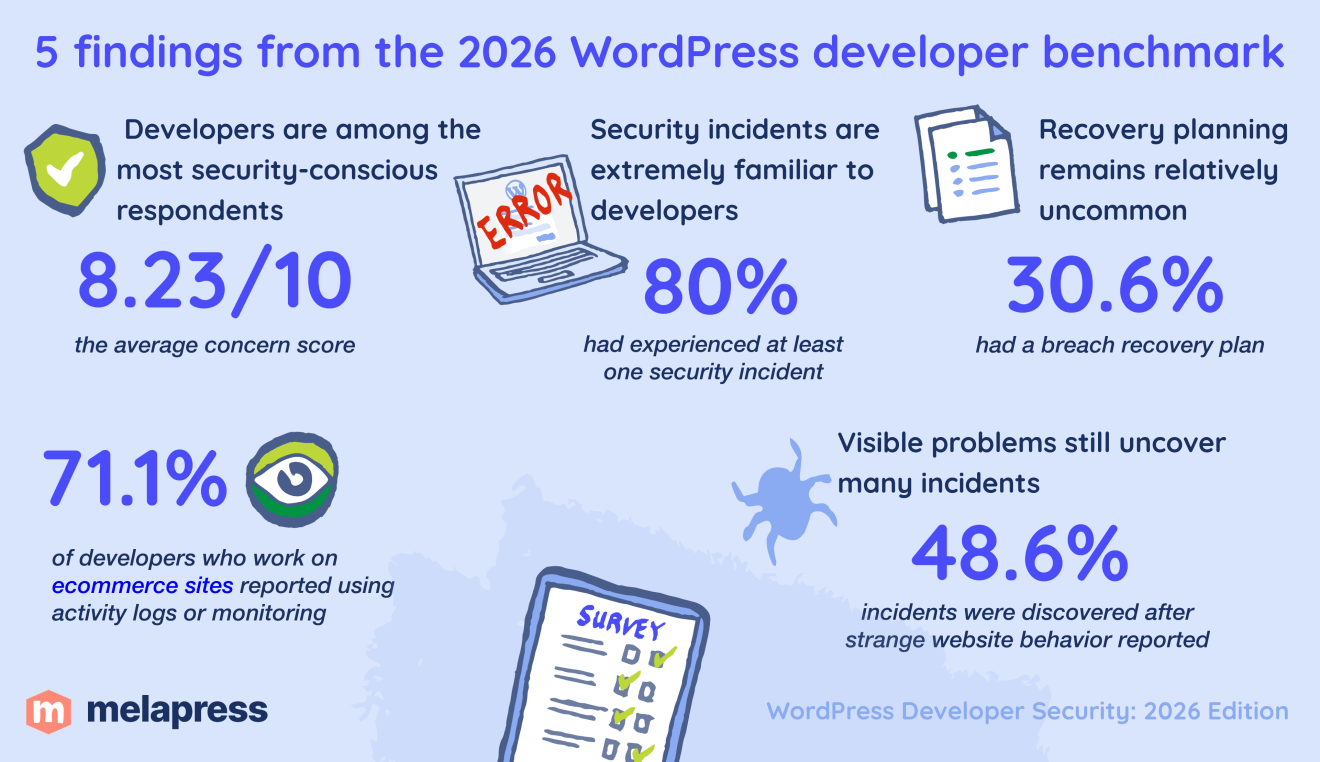
- The average security concern of WordPress developers was scored at 8.23 out of 10.
- 80.0% of WordPress developers had encountered at least one security incident.
- 60.0% of developers who experienced an incident selected at least two impacts from their most serious incident, compared with 43.9% of non-developers.
- 69.4% of developers who had experienced an incident in the past did not report having a current breach recovery plan.
- 71.1% of developers who work on ecommerce sites reported using activity logs or monitoring, compared with 37.7% of other developers.
- 44.4% of developers with a confirmed incident selected a hosting or server alert as a discovery method, compared with 31.2% of non-developers.
Four in five WordPress developers have experienced a security incident
80.0% of developers answered that they had experienced at least one security incident. Repeat incidents were also very common, with 72.2% of those who experienced an incident having experienced two or more. This means that only 27.8% of developers with a confirmed incident reported experiencing exactly one.
Side note: These figures describe respondents’ experience, not incidents per website. Developers may work across many sites or be brought in after a compromise, so the results do not show that websites they secure are more likely to experience an incident.
What impact did security incidents actually cause?
Out of the developers who experienced a security incident, the reported consequences were:
- Website downtime: 67.1%
- Reputational damage: 38.6%
- Loss of search rankings: 30.0%
- Loss of client trust: 24.3%
- Revenue loss: 21.4%
- Data theft or loss: 10.0%
- Compliance or legal issues: 4.3%
Note: Respondents could select multiple impacts.
Security incidents can have several consequences at once
The impacts often extended beyond a website going offline. In fact, 60.0% of developers selected at least two consequences, compared with 43.9% of non-developers.
This was particularly common among developers who work on ecommerce sites. Of those who answered the impact question, 81.3% selected two or more impacts, compared with 42.1% of developers who did not select ecommerce. Website purpose and incident impact were reported separately, so this does not tell us whether the affected website was an ecommerce site, but the difference is interesting to note.
There may also be a connection between visible symptoms and reputational consequences. Reputational damage was selected by 54.3% of WordPress developers who said someone reported strange website behavior, compared with just 22.9% who did not select that discovery method. This, again, is an exploratory comparison that doesn’t establish which happened first or whether one caused the other.
For developers, removing malware, restoring files, or fixing a compromised account may therefore be only part of the response. The organization may still be dealing with lost rankings, customer concerns, or reputational damage after the technical work is complete.
Developers are highly concerned about WordPress security
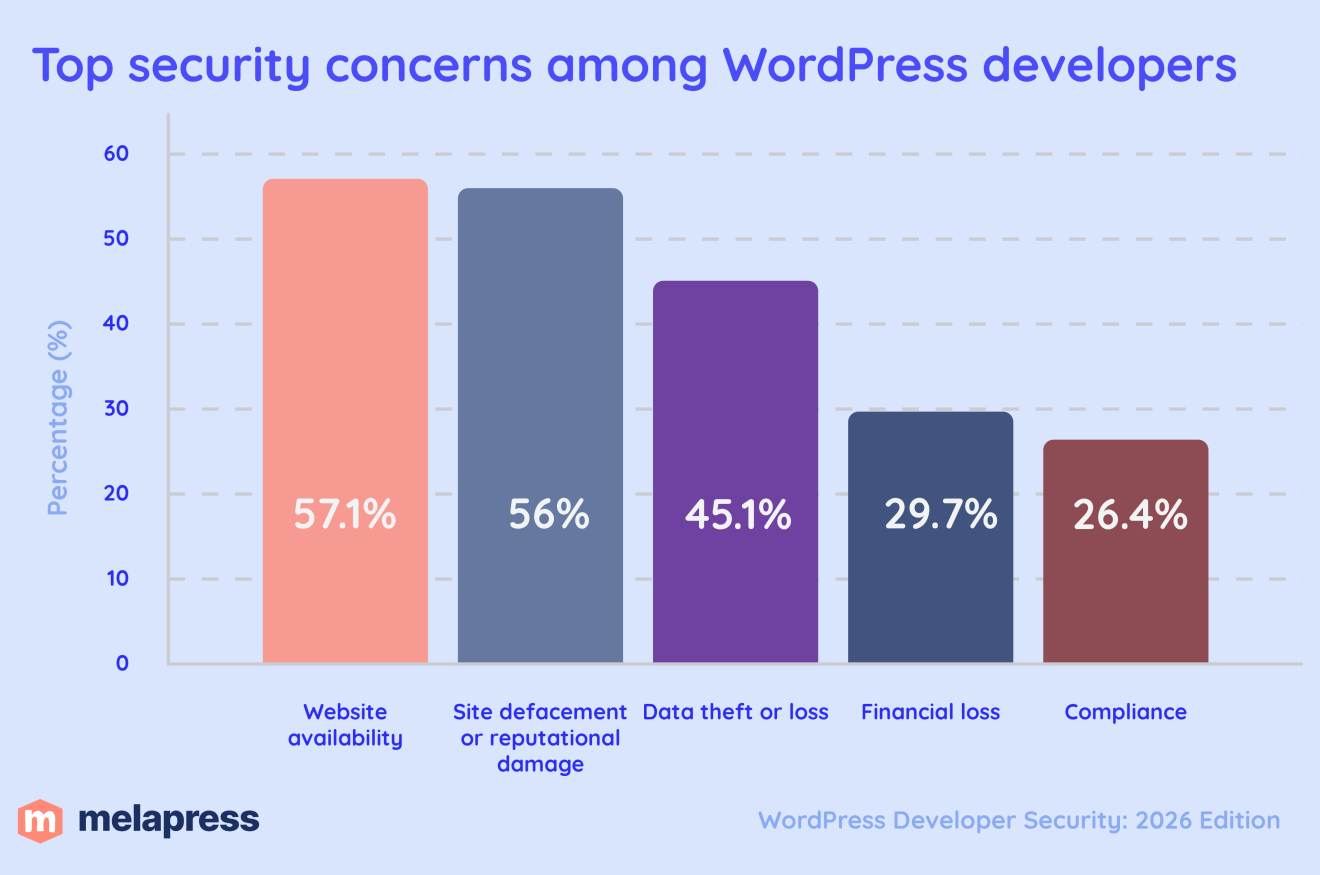
The consequences reported above provide context for what developers said concerns them most. Developers rated their concern about WordPress security at an average of 8.23 out of 10. More than four in five rated it at 7 or higher, while more than half selected 9 or 10.
Their most commonly selected concerns were:
- Website availability: 57.1%
- Website defacement or reputational damage: 56.0%
- Data theft or loss: 45.1%
- Financial loss: 29.7%
- Compliance: 26.4%
The ranking broadly matches the incident impacts discussed above: downtime was the leading consequence, while reputational damage was also commonly reported.

Subscribe for more survey stats we haven’t published yet.
How developers discover security incidents
Out of the developers with a confirmed incident, the following discovery methods were selected:
- Strange website behavior: 48.6%
- Hosting provider or server alert: 44.4%
- Logs or logging-tool alerts: 38.9%
- Malware scanner: 27.8%
- Search engine warning: 15.3%
Note: Respondents could select multiple impacts.
Hosting infrastructure plays a particularly visible role
Hosting or server alerts were selected by 44.4% of developers with a confirmed incident, compared with 31.2% of non-developers. Logs or logging-tool alerts were selected at almost the same rate in both groups: 38.9% of developers and 38.2% of non-developers. The hosting comparison is therefore the more distinctive result here.
The discovery methods also overlapped. Of developers who selected strange website behavior, 65.7% also selected a logging alert, malware scanner or hosting/server alert. Across all developers with a confirmed incident, 15.3% selected strange behavior without any other discovery method.
The survey does not tell us which signal appeared first. What it does show is that a report of strange behavior often appeared alongside a technical alert. For developers, monitoring inside WordPress and signals from the wider hosting environment both deserve attention.
What does the developer security stack look like?
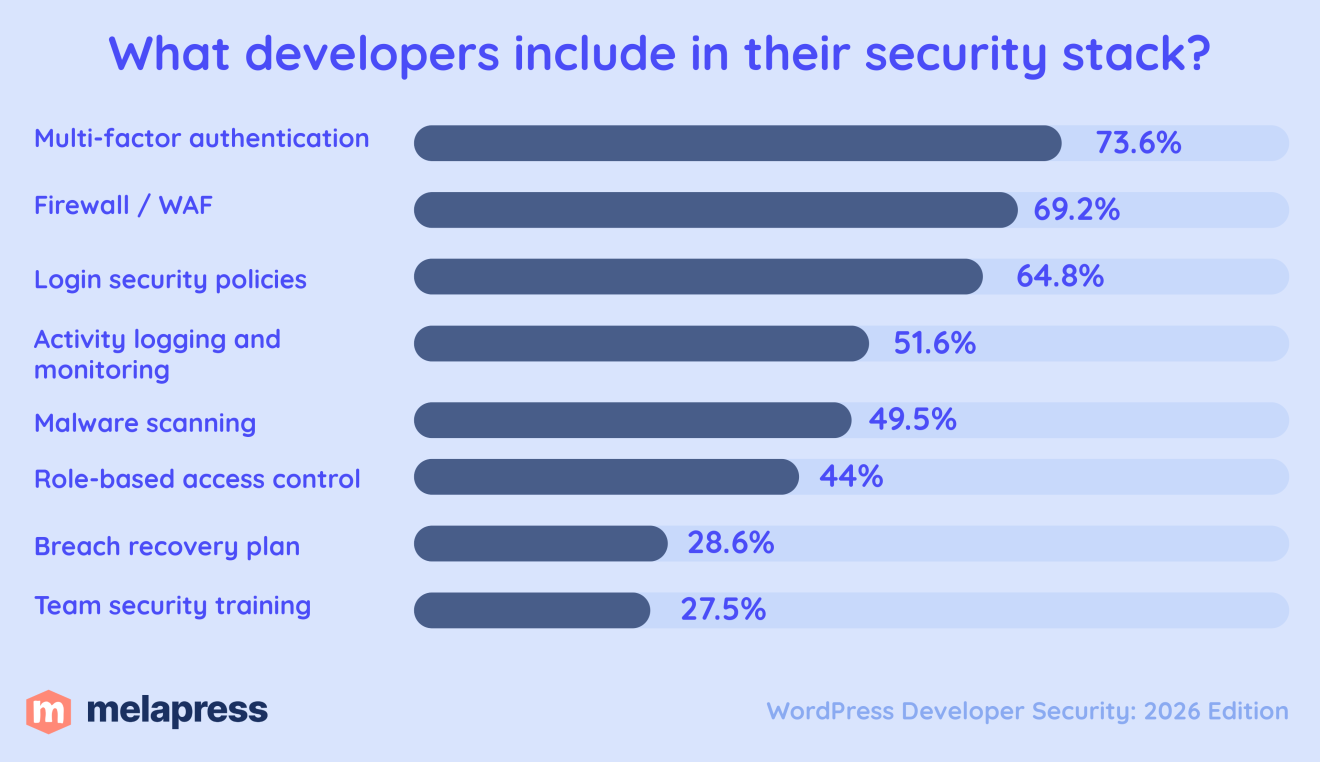
Developers reported an average of 4.09 of the eight security controls measured in the survey. Adoption was highest for authentication, firewalls, and login-related measures, but other controls were also particularly common.
The overall pattern is weighted toward preventing unauthorized access and blocking threats. Monitoring and recovery are less consistently reported, although the number of controls selected does not tell us how well any of them are implemented. The overall figures also hide substantial differences within the developer group, particularly in the use of activity logs and monitoring.
Activity logging varies within the developer group
Overall, 51.6% of developers reported using activity logs or monitoring, compared with 59.2% of non-developers. However, that average conceals a much larger difference within the developer group. 71.1% of developers who work on ecommerce sites reported using logs or monitoring, versus only 37.7% who did not select ecommerce.
Interestingly, the developer to non-developer gap is concentrated around respondents who did not select ecommerce. In that group, 37.7% of developers reported using logs or monitoring, compared with 59.4% of non-developers. These are comparisons between respondents who work on different types of sites, so they do not tell us which controls are installed on any particular website.
Monitoring and recovery planning also tended to appear together. Out of the developers who reported using activity logs or monitoring, 51.1% also reported having a breach recovery plan, compared with 4.5% of developers who did not report using logs or monitoring. The survey cannot tell us where this difference comes from, but the pattern suggests that the recovery gap is rarely isolated from the monitoring gap.
Technical expertise does not remove the need for recovery planning
The contrast between past incident experience and current recovery planning becomes clearer when we look at the same respondents. Of the developers who reported a confirmed incident, 69.4% did not report having a breach recovery plan at the time of the survey. Even among those who reported experiencing two or more incidents, 61.5% did not report a plan.
Developers who reported multiple incidents were more likely to report a current recovery plan than those reporting exactly one incident: 38.5% versus 10.0%. The survey records past incidents and current controls, so it cannot tell us whether the incidents prompted those plans.
Preventative controls reduce risk, but developers also need a documented process for responding and restoring a website when an incident occurs.
Security is usually managed directly by developers themselves
The management data also gives useful context to the results. Out of the WordPress developers in our survey:
- 62.6% said they manage WordPress security themselves.
- 22.0% said it is managed by an in-house developer or systems administrator.
- 7.7% rely on an agency.
- 6.6% rely on a freelance developer or systems administrator.
- 1.1% reported another arrangement.
The first figure is unsurprising given the group being surveyed, but it reinforces how directly involved developers are in security decisions.
For many developers, security is not something delegated to a separate specialist. It forms part of a wider responsibility that may also include development, maintenance, performance, infrastructure, plugin management, and troubleshooting.
There was also a difference in reported preparation depending on who managed security. Out of the developers who said they managed it themselves, 22.8% reported a breach recovery plan and 19.3% reported team security training. And of the developers who said security was managed by an in-house developer or systems administrator, 45.0% reported a recovery plan and 50.0% reported team training.
Note: The in-house group is small, and team training may be less relevant to some individual developers, so these figures are useful context rather than evidence that one management arrangement leads to better preparation.
This makes security processes especially important. If one person holds much of the technical knowledge, organizations need to ensure that incident response, recovery procedures, and access are not dependent entirely on that person’s availability.
What developers can take from the benchmark
- Use strong authentication, login protections, and appropriate access controls to reduce the likelihood and potential scope of account compromise.
- Monitor WordPress activity alongside server, hosting, and malware signals rather than relying on users to notice that something looks wrong.
- Make sure backups can actually be restored, not simply that they exist.
- Document what should happen after an incident, particularly when multiple people or clients depend on the website.
- Avoid concentrating all security knowledge and access with one person where possible.
- Treat recovery, communication, and post-incident investigation as part of security rather than work that begins only after preventative controls have failed.
The developer benchmark highlights a useful reality of WordPress security in 2026: experience helps, but it does not make incidents disappear.
For the people closest to WordPress technically, the next level of security maturity is more about ensuring that detection, response, and recovery are just as well developed as the general security controls already implemented by most.
Join the WordPress Security discussion on our Reddit community
Who we surveyed and methodology
- This report looks at a subgroup of the full 319-response 2026 WordPress Security Survey. It includes 91 respondents who identified themselves as developers.
- Respondents could select more than one role and work across different types of WordPress websites. As a result, “developer respondents” does not mean these respondents worked exclusively as developers or on one particular type of website.
- If an individual question was left unanswered or had no valid response, that answer was excluded from the calculation for that question. As a result, the number of responses used varies between some findings.
- The survey shows associations, not causation. For example, differences in the use of activity logs, recovery plans, or other controls do not show that those controls caused a higher or lower incident rate. We also do not know whether respondents’ current security controls were in place when previous incidents occurred.
- Incident experience is reported by respondents, not per website. Developers may work across multiple websites or become involved after a compromise, so the results should not be interpreted as showing that websites managed by developers are more likely to experience security incidents.
Small disclaimer: This report focuses on 91 developers from the wider 2026 survey, so the findings reflect the experiences of this subgroup rather than all WordPress developers. Some comparisons also involve smaller groups within the sample, so they are best viewed as useful patterns rather than definitive conclusions.