



Published on 23 September, 2026 by Bram Vergouwen Reviewed by Robert Abela
WordPress Membership Site Security: 2026 Benchmark Report
Membership sites have a security challenge that many simpler WordPress websites don’t. When users are part of the system, you’re often a whole lot more vulnerable than, say, a blog where people just go to read without logging in.
Accounts, member data, gated content, and, in some cases, subscriptions or payments all increase the importance of controlling who can access what, as well as knowing what is happening on the website at any given time.
Our 2026 WordPress security survey showed this difference clearly.
Out of the 68 respondents who said they worked with membership websites, security concern was high. Adoption of several security controls was also substantially above the rest of the survey, and previous security incidents were extremely common.
This post dives into the current state of security for membership websites working on WordPress. In it, we’ll cover how those working on WordPress membership websites approach security, as well as how this group compares to other groups in the survey.
Want to read the full report? Check out the full Melapress WordPress Security Survey findings.
Membership-site security at a glance
Out of the 68 membership-site respondents:
- Security concern averaged 8.18 out of 10, with 85.3% rating their concern between 7 and 10.
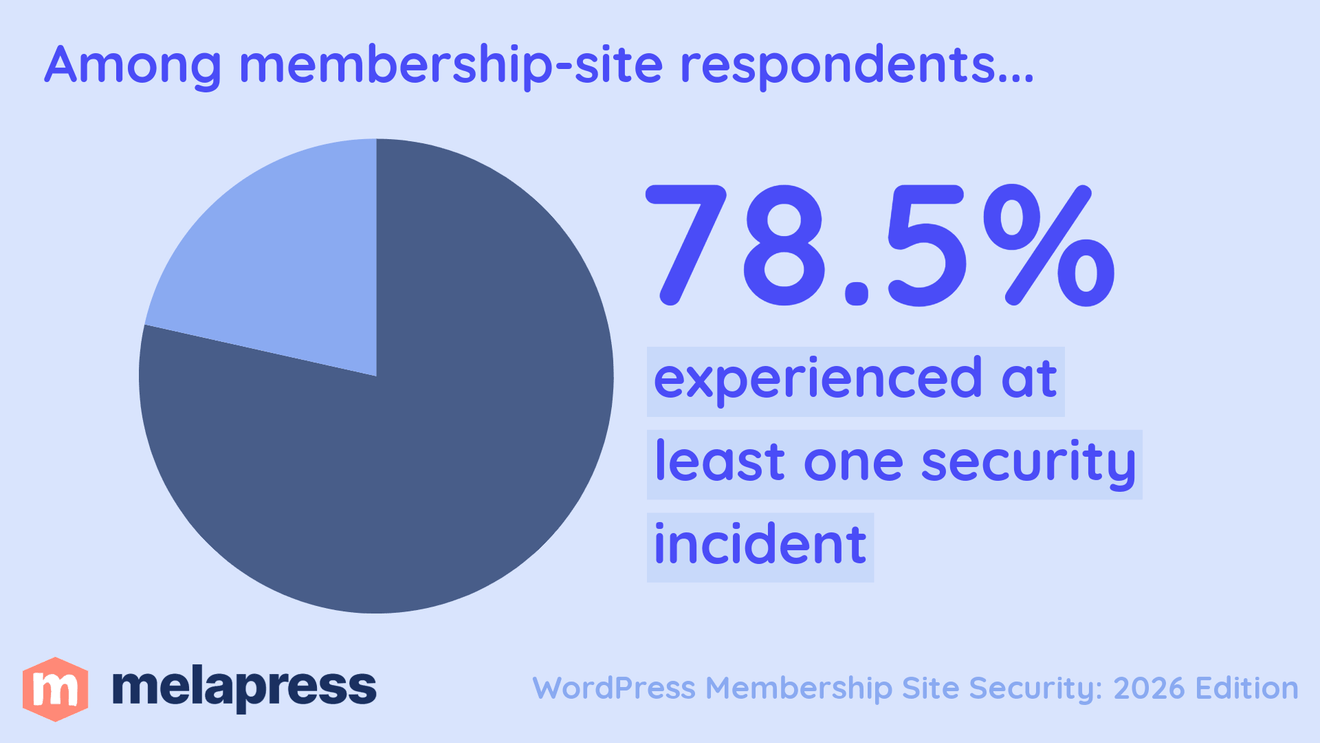
- 78.5% of respondents had experienced at least one security incident.
- 74.5% of those who had experienced an incident reported two or more.
- Role-based access control showed the largest difference, used by 66.2% of membership-site respondents compared with 37.8% of other respondents.
- Activity logs or monitoring were used by 75.0%, compared with 52.2% of respondents outside the membership-site group.
- Recovery planning was considerably more common but still far from universal. 44.1% had a breach recovery plan, compared with 23.5% of other respondents.
Member data, availability, and reputation dominate security concerns
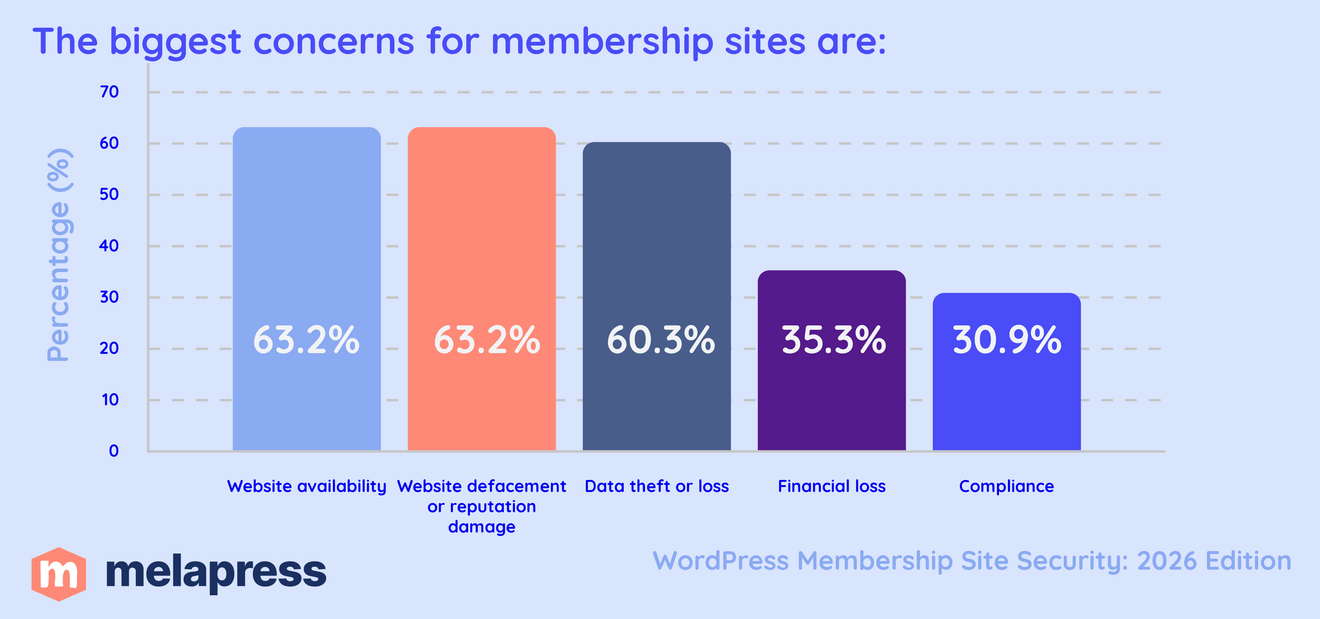
Three concerns stand clearly above the others for membership websites. Here is what they said they were most concerned about:
- Website availability: 63.2%
- Website defacement or reputational damage: 63.2%
- Data theft or loss: 60.3%
- Financial loss: 35.3%
- Compliance: 30.9%
Unlike some other groups, there is no single dominant concern. Availability and reputational damage are tied at the top, with data theft only three percentage points behind.
That combination fits the operating model of many membership sites.
A membership website depends on being continuously available while also holding user information and acting as the main point of interaction between an organization and its members. A security incident can therefore affect the service itself, the information behind it, and users’ trust/confidence in it.

Subscribe for more survey stats we haven’t published yet.
Concern about data theft is considerably higher than elsewhere
60.3% of membership-site respondents selected data theft or loss, compared with 42.6% of respondents outside the membership-site group. That is a difference of 17.7 percentage points.
Membership respondents were also more concerned about website defacement or reputational damage, scoring 63.2% compared to 51.8% for those not working on membership websites. Website availability at 63.2% compared to 53.8%, and financial loss at 35.3% compared to 26.3%, were also elevated concerns.
The data suggests that membership-site respondents see security as affecting several parts of the website at once rather than being primarily about preventing one particular type of concern.
Membership sites stand out for access control and monitoring
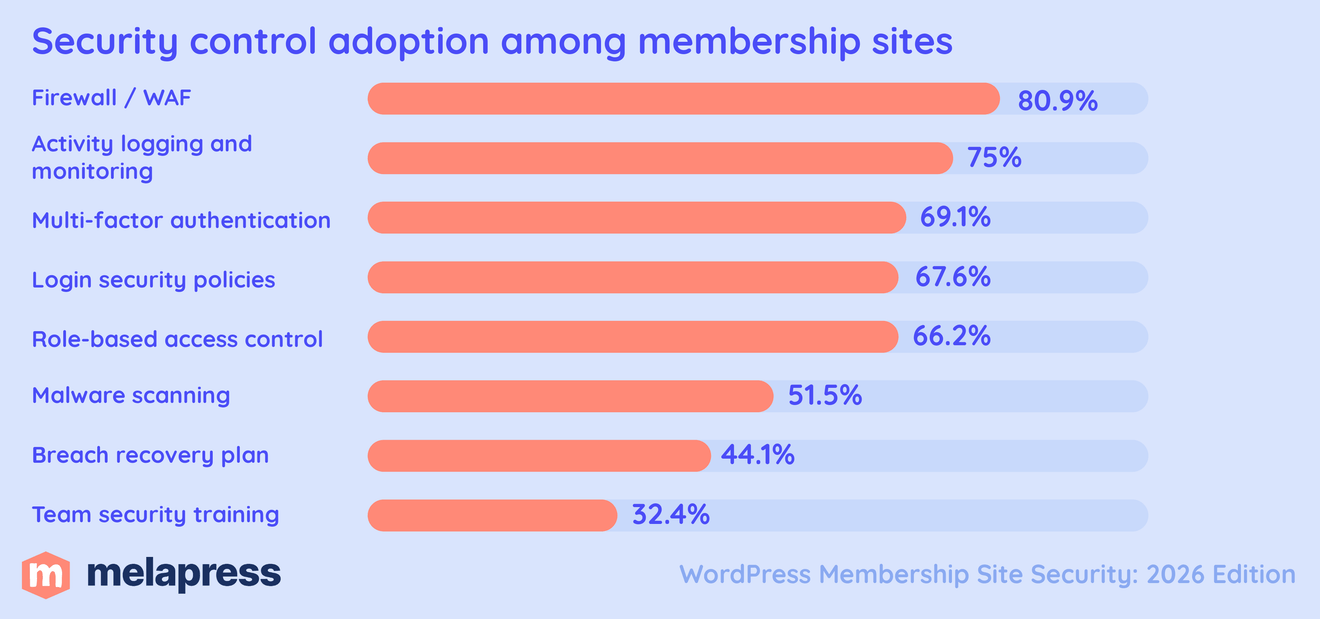
The security-control data is where this group differs most clearly from the wider sample. Membership-site respondents reported an average of 4.87 of the eight measured controls. These include:
- Firewall protection, including WAF: 80.9%
- Activity logging and monitoring: 75.0%
- Multi-factor authentication, including 2FA: 69.1%
- Login security policies: 67.6%
- Role-based access control: 66.2%
- Malware scanning: 51.5%
- Breach recovery plan: 44.1%
- Team security training: 32.4%
Firewalls or WAFs were the most commonly reported control, used by 80.9% of respondents.
Activity logging was also particularly common at 75.0%, while roughly two-thirds reported using both login security policies and role-based access control (RBAC).
Role-based access control shows the largest difference
The strongest difference between membership sites and the rest of the survey appears in role-based access control.
66.2% of membership-site respondents used role-based access control, compared with 37.8% of the rest of the sample. That is a 28.4 percentage-point difference.
This is one of the clearest examples in the survey of the type of website aligning with the controls respondents choose.
Membership sites often need to distinguish between different types of users and determine what each can see or do. Restricting privileges according to role is therefore especially relevant.
The benchmark does not tell us how those roles are configured or how regularly permissions are reviewed, but it does show that access control is much more widely used within this group.
Monitoring is also substantially more common
75.0% of membership-site respondents reported using activity logs or monitoring, compared with 52.2% of other respondents. That represents another large difference of 22.8 percentage points.
For websites with registered users, account activity and changing permissions, having visibility into what happens after someone logs in can be particularly useful.
The survey data suggests membership-site respondents are considerably more likely to have that visibility in place.
Recovery planning is stronger, but still far from universal
Membership-site respondents also stand out in an area where the wider survey showed relatively weak adoption, namely breach recovery planning.
44.1% reported having a breach recovery plan, compared with just 23.5% among the rest of the sample. That is a difference of 20.6 percentage points. It is one of the largest gaps between membership sites and other respondents.
However, the result can be read in two ways.
Membership sites are clearly ahead of the wider benchmark, but more than half still did not report having a breach recovery plan. This matters because the group also reports a very high level of previous security incidents.
A stronger-than-average result is not necessarily a strong result in absolute terms.
The same applies to security training. Membership respondents were more likely to report training than the rest of the survey, at 32.4% versus 24.3%, but it remains one of the least commonly adopted measures.
Nearly eight in ten have experienced a known security incident
Of the membership-site respondents who provided a known incident status, 78.5% had experienced at least one security incident.
Repeated incidents were also common.
Out of those respondents with a confirmed incident, 74.5% had experienced two or more.
Put another way, only around one quarter of membership respondents who had experienced an incident reported experiencing exactly one.
As with the other groups in this survey, this does not establish that the controls respondents currently use were in place when those incidents occurred. Some controls might have been introduced after an incident. Respondents may also work across multiple membership websites, increasing their lifetime exposure to security problems.
What the figure does establish is that security incidents are common for this group.
Monitoring plays a major role in discovering incidents
The way membership-site incidents were discovered is also very interesting because this group reports such high monitoring adoption.
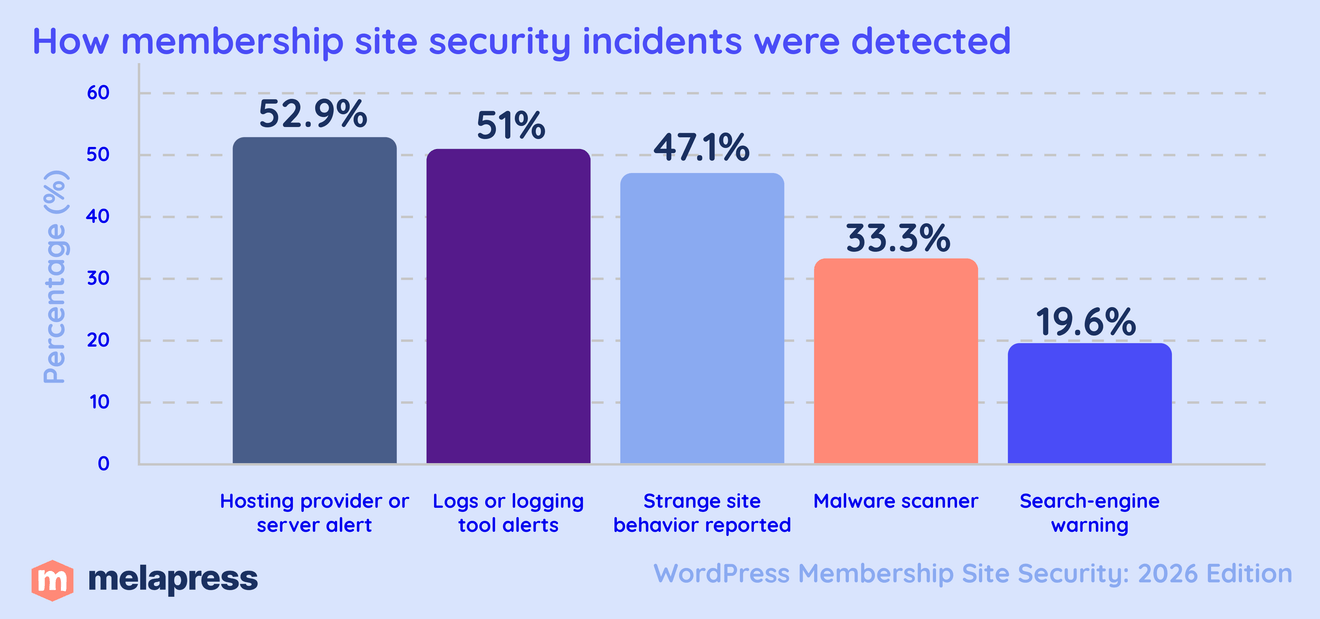
Out of the respondents with a confirmed incident who shared how they discovered the incident:
- Hosting provider or server alert: 52.9%
- Logs or logging-tool alerts: 51.0%
- Strange behavior reported by someone: 47.1%
- Malware scanner: 33.3%
- Search-engine warning: 19.6%
Note: Multiple discovery methods could be selected.
Unlike some other groups in the survey, technical detection methods occupy the top two positions. Hosting or server alerts were the most commonly reported method, with logs and logging-tool alerts almost exactly level.
That aligns with the group’s high adoption of activity monitoring, and shows that it can be an effective control for detecting security incidents.
Human observation is still important
Even with relatively strong monitoring, 47.1% said strange behavior reported by someone helped uncover an incident. Interestingly, in the broader security survey that included all groups, this was the most common way for WordPress site owners to discover an incident.
For membership sites in particular, members themselves can form part of the early-warning system. The goal should be to combine those reports with monitoring that allows the technical team to investigate what happened and how far the problem extends.
Downtime is the most common incident impact
Out of the membership-site respondents with a confirmed incident, the most common impacts were as follows:
- 69.4% experienced website downtime.
- 38.8% reported reputational damage.
- 32.7% reported loss of client trust.
- 24.5% lost search rankings.
- 22.4% reported revenue loss.
- 4.1% reported data theft or loss.
- 4.1% reported compliance or legal issues.
Note: Multiple impacts could be selected.
Trust is an important part of the impact
Downtime was clearly the most common consequence, affecting more than two-thirds of respondents who answered the question. But the figures relating to reputation and trust are also interesting.
38.8% reported reputational damage, while 32.7% reported a loss of client trust.
For membership sites, that relationship can be particularly important because the website often represents an ongoing service rather than a one-off visit.
Users may repeatedly log in, maintain accounts, access member resources, or interact with the organization through the site. A security incident can therefore affect an established relationship with those users.
Interestingly, data theft itself was reported as an impact much less frequently, at 4.1%, despite being a concern for 60.3% of membership-site respondents.
Note: That should not be interpreted as evidence that concern about data theft is misplaced. The survey compares current concerns with previous incident impacts, and lower-frequency outcomes may be more serious than impacts that are more common. Another angle could be that membership sites are especially well protected against data theft, making this less common of a materialized impact.
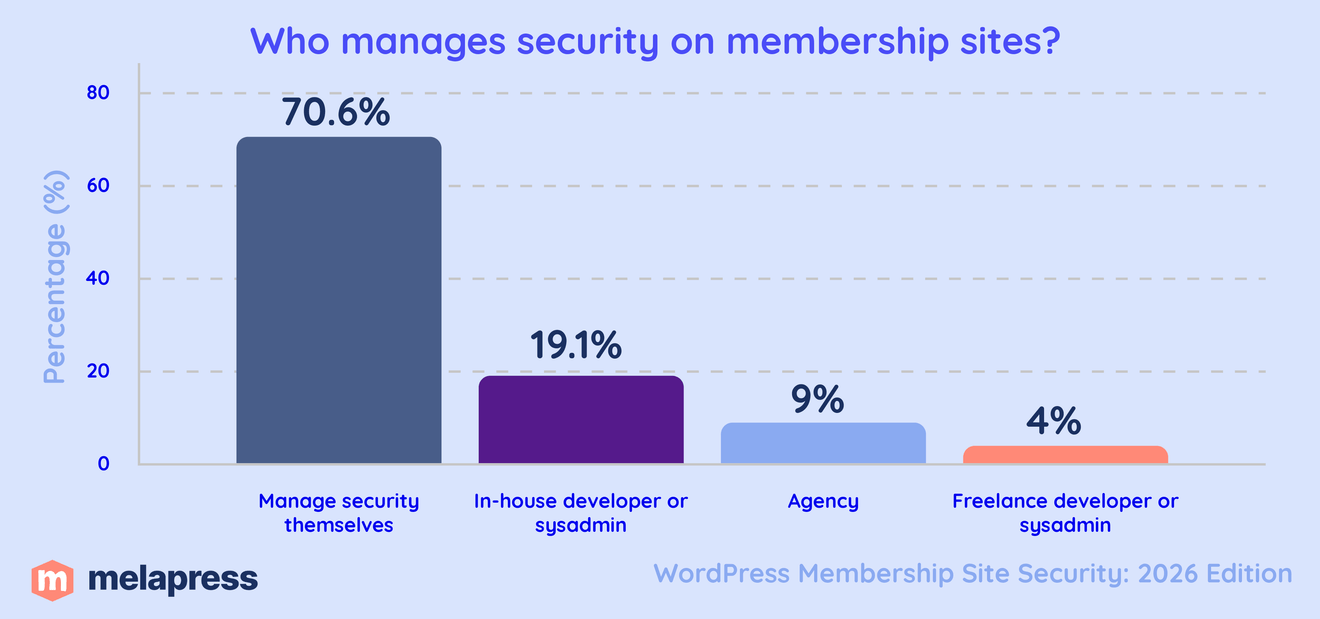
Most membership-site respondents manage security themselves
Security responsibility is heavily concentrated with the respondent themselves. Out of the membership-site respondents:
- 70.6% said they manage WordPress security themselves.
- 19.1% rely on an in-house developer or systems administrator.
- 5.9% use an agency.
- 4.4% use a freelance developer or systems administrator.
That means just over seven in ten respondents said they were personally responsible for security.
This does not mean seven in ten membership websites have no wider technical support. Respondents may themselves be developers, administrators, website owners, or members of internal teams.
It does, however, highlight an important operational reality. Even on websites with potentially complex user and access requirements, WordPress security is frequently owned directly by an individual.
That makes documentation and clear processes important, particularly when one person holds much of the knowledge about access, monitoring, backups, and incident response.
Where membership sites differ most from other WordPress websites
Looking across the survey, membership sites do not simply report more concern. They also report a noticeably different security setup.
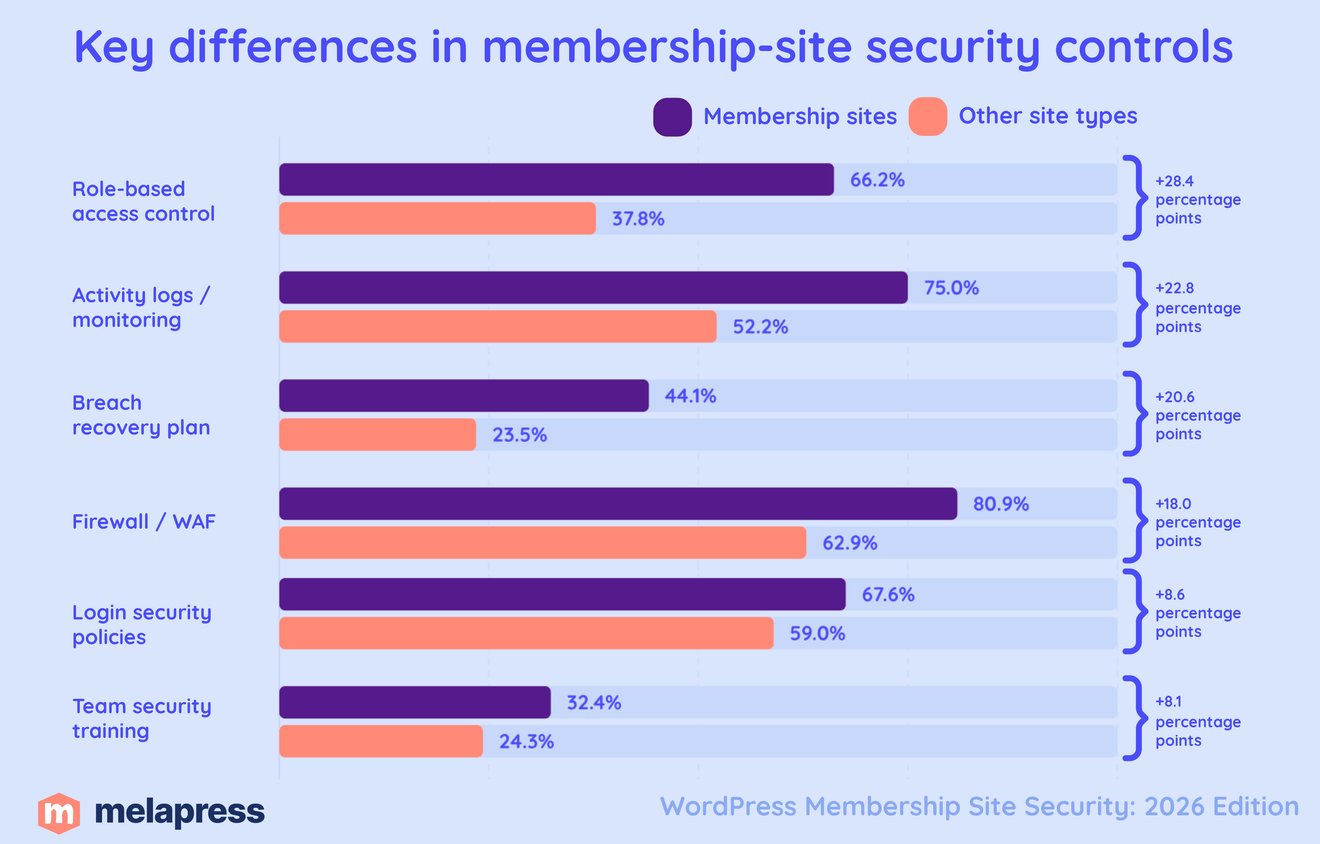
These include a much higher rate of role-based access control, activity logs/monitoring, firewall/WAF use, login security policies, team training, and breach recovery planning.
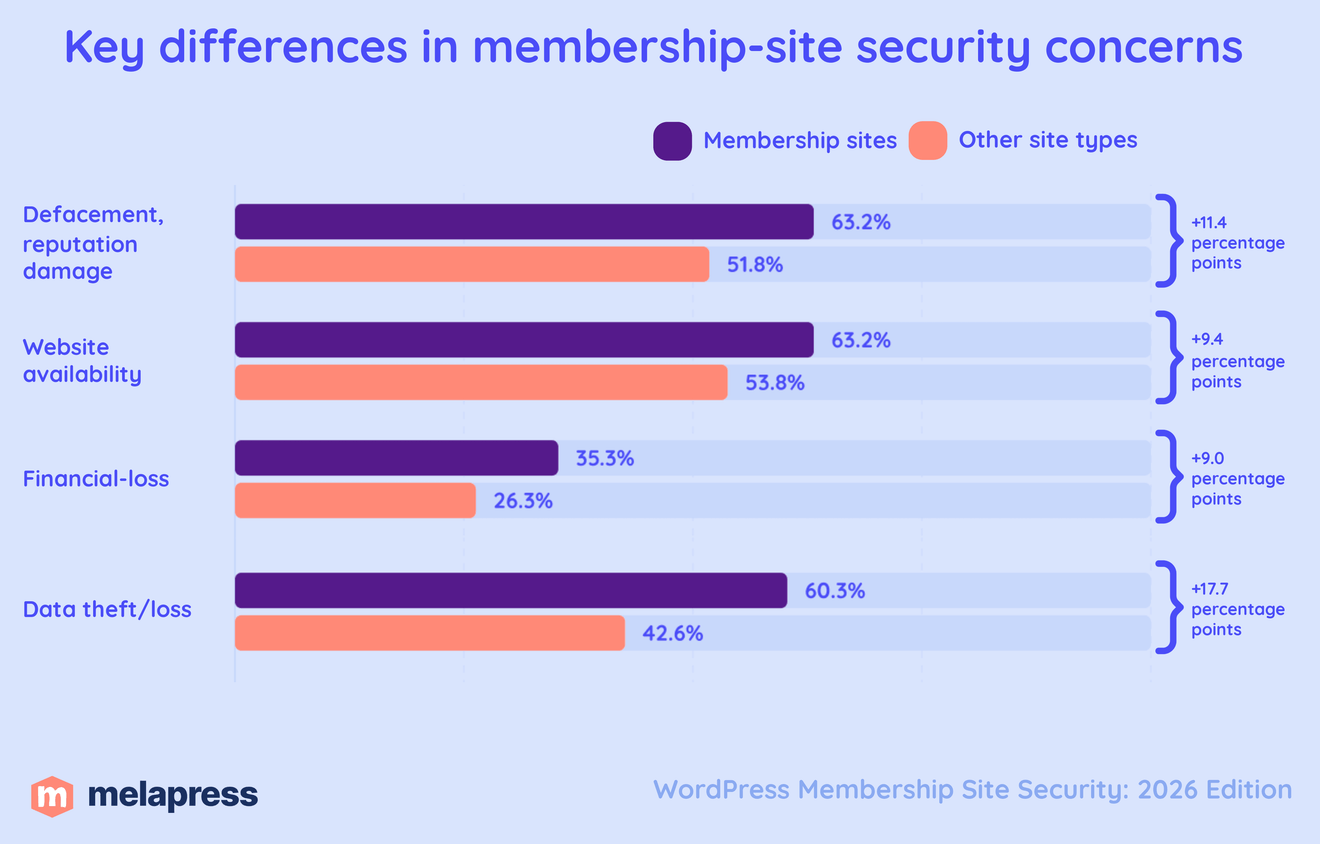
It also includes a greater concern about data theft, website defacement/reputation, website availability, and financial loss.
What membership-site teams can take from the benchmark
Membership websites create security requirements that go beyond simply protecting the WordPress administrator account.
For teams responsible for these sites, the survey points to several practical priorities:
- Control access according to what each user actually needs. Membership websites often have several user types, making appropriate roles and permissions particularly important.
- Protect privileged accounts. Apply 2FA or MFA and stronger login policies where compromise would give an attacker significant access.
- Keep visibility over user and administrative activity. Logging is especially useful when websites have many accounts and changes taking place inside them.
- Combine WordPress monitoring with hosting and server alerts. Both played an important role in discovering incidents among survey respondents.
- Plan for the website becoming unavailable. Test backups and establish how service will be restored if preventative controls fail.
- Decide how member communication will work during an incident. Security response is not only a technical process when users depend on continued access to the website.
- Document security responsibilities. This becomes particularly important when a single developer, administrator or website owner manages most of the setup.


Add an extra layer of protection to member and administrator logins with 2FA.
The membership-site benchmark shows a group that appears to recognize many of these risks already.
Compared with the rest of the survey, membership respondents use more access controls, more monitoring, more firewalls, and considerably more recovery planning.
Yet incidents remain common, and not all controls are implemented fully.
For membership sites, that makes visibility, access management, and recovery just as important as preventing the initial compromise.
Extra resources
There are many resources online that can help you strengthen the areas covered in this benchmark and turn the recommendations above into practical steps. Below are some of our top picks:
- The complete guide to WordPress security
- Strengthen WordPress login security with passkeys
- And if you want to dive deeper into security, listen to our Melapress Show episode on building secure and scalable membership sites
Join the WordPress Security discussion on our Reddit community
Who we surveyed and methodology
- This report looks at a subgroup of the full 319-response 2026 WordPress Security Survey. It includes 68 respondents who said they worked on membership websites.
- Respondents could select more than one type of website. As a result, “membership-site respondents” does not mean these respondents worked exclusively with membership websites.
- Where an individual question was left unanswered or did not have a valid response, that answer was excluded from the calculation for that question. As a result, the number of responses used can vary slightly between findings.
- Questions about how security incidents were discovered and what impact they had allowed respondents to select more than one answer. Percentages for these questions therefore can tally to more than 100%.
- With a subgroup of 68 respondents, small differences should not be treated as definitive. The comparisons in this report are most useful for highlighting the larger differences between membership-site respondents and the rest of the survey.
- The survey shows associations, not causation. For example, higher adoption of a particular security control does not mean that control caused a higher or lower incident rate. We also do not know whether respondents’ current controls were in place when previous incidents occurred.